9 Byword Alternatives for Bulk SEO Content in 2026
Byword alternatives for bulk SEO content, compared on cost at 30 and 300 articles, templates and team seats. Prices checked on 23 September 2026.
September 23, 2026 · 18 min read
On this page11 sections
- Key Takeaways
- Campaigns or a Daily Autopilot: Which Workflow Do You Need?
- What Byword Charges, Seat by Seat
- Byword Alternatives That Run on a Schedule
- Byword Alternatives That Match Its Volume for Less
- Byword Alternatives for Affiliate Sites and Semrush Teams
- What Byword Alternatives Cost at 30 and 300 Articles a Month
- Publishing in Bulk Without Tripping Google's Spam Policies
- What Byword Does Better
- Before You Cancel Byword
- Frequently Asked Questions
The short answer
The best Byword alternatives depend on how you use Byword today. If you run one site and want a new article on a schedule, Rankbox does that for $49.50 a month for 30 articles. If you want Byword's volume for less, Machined sells 250 articles for $99 and SEOWriting.ai up to 250 for $79. If you build pages from a spreadsheet or run a team across client sites, Byword is still the stronger buy.
This page covers Byword.ai, the AI article writer, not the Markdown editor for Mac. Byword writes in batches: campaigns from keywords, titles, or a spreadsheet, and programmatic templates for 100 to 10,000+ pages. So we judged Byword alternatives on what its buyers pay for: volume, templates, team seats, and the cost of 300 articles a month.
We make Rankbox, and it's ranked first. Prices were checked on 23 September 2026 on each vendor's own site, and per-article figures are our arithmetic. Marketing-copy tools like Jasper and Copy.ai, common on other lists of Byword alternatives, are left out.
Key Takeaways
- Byword charges $99 a month for 25 articles ($3.96 each) and $999 for 300 ($3.33 each). Seats and the API start at $299.
- Rankbox is $49.50 for 30 articles on one site, about $1.65 each. That's cheaper than Byword per article but not the cheapest here, and it has no templates or bulk runs.
- At about 300 articles a month, four Byword alternatives cost $0.53 to $0.60 an article: SEOWriting.ai, Junia AI, Autoblogging.ai, and Machined's own-key plan.
- Byword Unlimited's own-key model costs $1,999 a month plus AI usage. Machined ($99) and ZimmWriter ($24.97, Windows) apply the same idea.
- Byword still wins on programmatic templates and seats with roles, and it publishes to HubSpot, Ghost, and Medium alike.
- Google acts on pages that add nothing, not on AI. Publish in batches you can read.
Campaigns or a Daily Autopilot: Which Workflow Do You Need?
Byword is a batch tool, and a capable one. Its campaign docs describe three inputs: keywords, titles, or titles with outlines pasted from a spreadsheet. Its programmatic templates take variables and conditional sections and fill them from CSV, Google Sheets, or Airtable.
Byword suggests campaign ideas from your domain and can spread a finished batch across days. Its docs don't describe a standing plan that picks the next topic every week with nobody starting a batch. The MCP docs say "Recurring MCP schedules are not available yet."
An autopilot works the other way round. You approve a plan once, and the tool picks, writes, and publishes each article on a cadence. You give up control of each batch, and the site keeps moving when nobody is watching. Which Byword alternatives suit you depends on that choice.
- Hundreds of keywords or rows of data: stay with batch tools such as Machined, SEOWriting.ai, Autoblogging.ai, and ZimmWriter.
- One site that should grow every week: use an autopilot such as Rankbox, Junia AI, SEObot, or Koala AI's Boost plan.
- Both: SEObot and Junia AI pair a schedule with programmatic tools. Compare their docs with Byword's templates before you commit.
What Byword Charges, Seat by Seat
Byword sells four plans on its pricing page. Annual billing takes 17% off and delivers the year's credits up front. These are the numbers the Byword alternatives below are measured against.
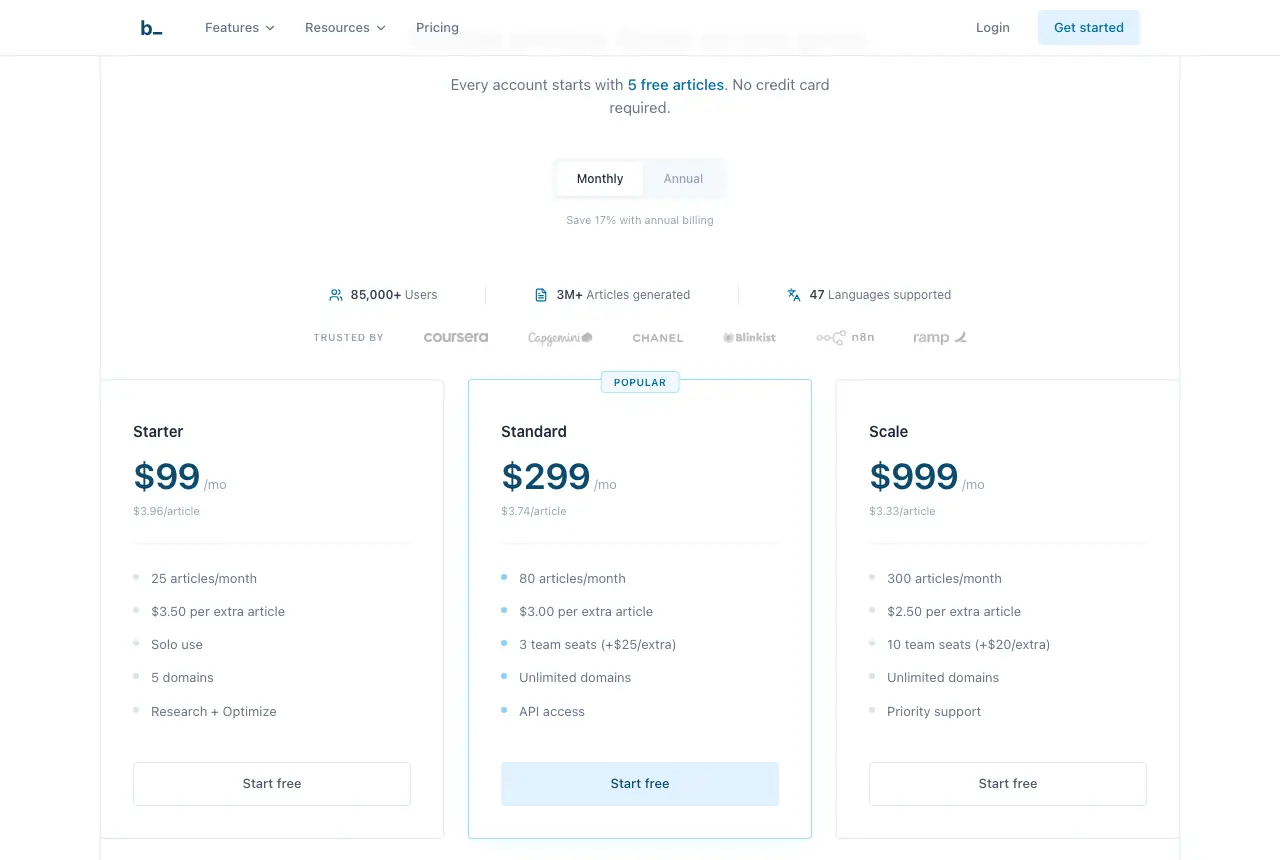
| Byword plan | Monthly | Articles | Per article | Seats | Domains |
|---|---|---|---|---|---|
| Starter | $99 | 25 | $3.96 | Solo | 5 |
| Standard | $299 | 80 | $3.74 | 3, up to 5 at $25 each | Unlimited |
| Scale | $999 | 300 | $3.33 | 10, up to 25 at $20 each | Unlimited |
| Unlimited | $1,999 plus AI costs | No cap | About $0.10 in AI costs | Unlimited | Unlimited |
Extra articles cost $3.50, $3.00, or $2.50 by plan. Seats and the API begin on Standard, so a team or a developer pipeline starts at $299. Unlimited swaps the cap for your own Anthropic and Google keys, and Byword says it "pays for itself at ~400 articles/month."
The free tier gives 5 articles with no card, a fair test of the writing, though CMS publishing needs a paid plan. Once you pay, the billing docs say "We don't offer automatic refunds." Rankbox subscriptions are non-refundable too. Review counts are small: 2.8 out of 5 from 7 on Trustpilot and 5.0 from one on Capterra, both seen on 23 September 2026.
AI visibility costs extra. It runs through Trakkr, a separate tracker led by Byword's founder, Mack Grenfell. Rankbox doesn't monitor AI citations yet either.
Byword Alternatives That Run on a Schedule
These three Byword alternatives swap batches for a plan the tool works through by itself.
1. Rankbox: a standing plan for one site
If your Byword account mostly runs one campaign a month for your own site, you may be paying for machinery you don't use. Rankbox swaps the campaign for a standing plan. Its answer-space research reads your site and lists the questions your buyers put to Google and to AI assistants. You approve the plan once, and it writes on the weekly cadence you set, up to one article a day.
Articles run about 2,750 words. The citation-ready writer builds each one from live research of the pages ranking now. Sources are cited inline and in a References list, with a direct answer up top and an FAQ at the end. It writes in the brand voice it reads from your site, which you can edit. Any draft that fails a check goes back through the writer until it passes the SEO and GEO score.
- Cost: $49.50 a month for 30 articles on one site, about $1.65 each, against $3.96 on Byword Starter. Extra sites are $49.50 each, with no yearly plan. You can try it for 7 days, with a card on file, and get up to 7 articles. Payments aren't refunded, apart from billing errors or where the law says otherwise.
- Delivery: a developer connects the Rankbox publishing API once. Plugins for WordPress, Webflow, Shopify, Framer, and Square are in the works. Its MCP link works in 49 AI tools, for research only. Byword's MCP server can also publish.
- Rolling out on paid plans (September 2026): a topic-matched backlink exchange (30 credits a month, 1 to 3 per link by host tier, no direct swaps, and credits move only once a link is verified live), plus Reddit reply drafts you post yourself.
What you give up coming from Byword: templates and bulk runs (the ceiling is 30 articles a month per site), measured keyword data (Rankbox estimates demand with AI), and seats (one login). A native CMS connector and live AI citation monitoring don't ship yet. Our Rankbox vs Byword page compares the two in full.
2. Junia AI: autopilot, an API, and seven CMSs from $59
Junia AI bundles Byword-style extras with a schedule. Bulk generation, API access, unlimited websites, and AutoBlog scheduling all come with its Scale plans, from $59 a month for 68 articles "generated and published on autopilot."
It publishes to WordPress, Shopify, Webflow, Wix, Blogger, Ghost, and Medium, plus a webhook and its own API. Scale plans add a content planner, automatic Google indexing, and team collaboration (seat count unpublished). A programmatic SEO tool sits in its menu.
Plans: Growth $34 for 10 articles (no autopilot), Scale Starter $59 for 68, Scale Plus $89 for 136, Scale Pro $159 for 283, and a free plan with no card. Yearly prices are half for now, under a limited-time countdown, and the price afterwards isn't shown.
Watch for: Scale Pro stops at 283, just short of 300, so bigger months mean extra credits. Trustpilot showed 3.9 out of 5 from 88 reviews on 23 September 2026, with some refund complaints.
3. SEObot: a schedule plus programmatic pages
SEObot pairs an autopilot with pages built from data. It plans content from your site, writes articles that average about 3,000 words, and publishes them within a daily or weekly cap. It also runs programmatic SEO projects from a data schema and an HTML template. Its publishing list runs from WordPress and Webflow to Framer, HubSpot, and Notion, plus a REST API and webhooks.
For agencies, credits never expire and can be split across websites, and you can invite teammates. The help center says "All SEObot users have equal permission levels," so there's no read-only role for clients like Byword's Viewer.
Price is where it stops being a saving. Monthly plans run $49 for 9 articles, $99 for 20, $199 for 50, and $1,050 for 300, with no yearly option. That's $3.50 an article at 300, slightly above Byword Scale. The $49 plan carries a full refund if you're unhappy after the first article. See Rankbox vs SEObot or our SEObot alternatives.
Byword Alternatives That Match Its Volume for Less
If you like running batches and just want them cheaper, these four Byword alternatives work most like Byword.
4. Machined: clusters in bulk, with seats on every plan
Byword's $99 buys 25 articles. Machined's Pro plan buys 250. And where Byword Starter is solo, every Machined plan has team members: 2 on Launch, 3 on Growth, 5 on Pro, and 10 on Scale and BYOK. All of them include unlimited projects (websites) and every feature.
It works from a seed keyword, not a spreadsheet. Machined "automatically finds hundreds of related keywords, groups them by search intent," and writes a topic cluster: a pillar page plus linked supporting articles. Same-intent keywords share one article, so a big run shouldn't produce competing pages. Research runs through Perplexity, and one set of bulk settings covers up to 50 articles of 1,200 to 3,200 words.
Price: Launch $19 (30 articles), Growth $49 (100), Pro $99 (250), Scale $249 (750), and BYOK $99 for up to 2,000 plus about $0.20 an article to your AI provider. Yearly billing takes 25% off. The 7-day Launch trial needs no card and won't charge you automatically. Once you're charged, there are no refunds. The allowance "Resets on renewal," unlike Byword's credits.
Check first: native publishing is WordPress and Webflow, with a webhook through Make, Zapier, or n8n for anything else. Its site doesn't describe calendar scheduling, and its docs and pricing page disagree on BYOK limits.
5. SEOWriting.ai: 250 articles for $79
SEOWriting.ai is built for cheap volume. Its pricing page sells up to 250 articles for $79 a month, about $0.32 each, or up to 1,000 for $307. Bulk mode auto-posts "up to 100 articles in a batch" to WordPress.
It reads the top 10 results for a keyword to set the article type, size, and outline, and writes up to 5,000 words. Agencies get more brand voices as they climb: 1, 5, 10, then 20 or 25 on the top plan (its card and table disagree).
- Plans: free (3 articles, no card), Starter $19 (up to 50), Professional $79 (up to 250), Pro Plus 1 $159 (up to 500), and Pro Plus 2 $307 (up to 1,000). Yearly billing takes 25% off.
- Limits: linking starts at Professional. Native publishing is WordPress and Shopify.
- Reviews: 4.6 out of 5 from 365 on Trustpilot on 23 September 2026. Some recent ones mention crashes.
6. Autoblogging.ai: CSV batches and credits that roll over
Autoblogging.ai feels most like Byword's campaigns. You upload a CSV of up to 500 articles, and unused credits "automatically roll over to the next month as long as your subscription is active."
Budget in credits. On its pricing page, a Godlike Mode article costs 2 credits and a Quick Mode article 1. Non-English articles add 1, and the Fact Checker, which adds sourced facts from live search, costs 2 more. The $179 Gold plan's 600 credits make 300 Godlike articles, or 150 fact-checked ones. That's about $0.60 an article at 300, by our arithmetic.
It publishes to 12 platforms, from WordPress and Shopify to Ghost and Medium. Connected sites go from 1 on Starter to 20 on Gold and unlimited on Premium ($249), where the API starts. It also tracks your place in Google's AI Overviews with a 0 to 100 score, which Byword leaves to Trakkr.
Plans: $19 to $999 a month for 40 to 5,000 credits, with bulk CSV from the $49 Regular plan. Yearly billing takes 35% off, and the free plan gives 10 credits a month.
Keep in mind: its targets include web 2.0 syndication sites, a volume tactic that may not suit a brand. Trustpilot showed 4.3 out of 5 from 69 reviews on 23 September 2026.
7. ZimmWriter: Byword Unlimited's idea at desktop prices
Byword charges $1,999 a month to run on your own AI keys. ZimmWriter sells that idea for $24.97 a month or $247 a year, as a Windows desktop app. You add OpenAI or OpenRouter keys, or free local models through Ollama, with "No Limits on Words & Articles."
It's sized for bulk. It can "Generate up to 1,000 blog posts with one click" or build 50 product roundups at once. Its Local SEO Buffet makes up to 625 service-and-location pages, the nearest match here to Byword's city templates, so read the doorway rule below first. Deep Research adds inline citations, and posts can be scheduled across up to 100 WordPress sites.
At 300 articles a month, the licence comes to about $0.08 an article, the smallest platform fee at that volume of any of the Byword alternatives here. Your AI usage comes on top. ZimmWriter's own example puts 1,000,000 words on GPT-4o Mini at about $1.00, stronger models cost more, and live Google data needs a $5-a-month ScrapeOwl account. It's Windows-only and WordPress-only, you manage the API accounts and bills, and its homepage lists no trial or refund terms.
Byword Alternatives for Affiliate Sites and Semrush Teams
These last two Byword alternatives suit narrower buyers.
8. Koala AI: bulk writing, metered in words
Koala AI suits Byword's affiliate buyers. Byword's own Byword vs Koala Writer page credits Koala with the better Amazon affiliate tools, and our Koala AI vs Byword page compares them in detail.
The catch at volume is the meter, because Koala sells words. Its pricing page bases allowances on GPT-6 Luna, with GPT-6 Sol and Claude Sonnet 5 counting at 2x and Claude Opus 5.5 at 3x. By our arithmetic, the $350 Elite plan's 1,000,000 words make about 400 articles of 2,500 words on Luna, so 300 cost about $1.17 each. On a 2x model, 300 need 1.5 million words, which is the $500 Advanced plan. Monthly words expire after a month, where Byword's credits don't.
Every paid plan includes bulk writing, live Amazon data, the API, and publishing to WordPress, Shopify, Webflow, and Ghost. From the $99 Boost plan, a Content Calendar Autopilot publishes each approved article "on its scheduled date without you opening the app." Bigger plans cover more brands (7 on Elite), but there are no team seats. Koala's pricing FAQ says you may share one account within your organization.
Price: from $25 (Starter) to $2,000 (Scale III), with Professional at $49 and Boost at $99. Yearly billing takes 20% off, and new accounts get 5,000 free words and 25 credits with no card. See Rankbox vs Koala AI or our Koala AI alternatives.
9. Semrush Content Toolkit: drafts backed by Semrush data
The Semrush Content Toolkit, formerly ContentShake AI, suits a team already on Semrush that wants drafts built on its data. It isn't a bulk engine: its pages describe no CSV uploads or scheduled autopilot.
One plan costs $60 a month. The help center lists unlimited standard articles, while the pricing page says 10,000 a month. Only 5 a month are "SEO-boosted" with deeper search-result analysis, and 10 more cost $30. It adds topic ideas, briefs, an AI Search Optimizer, up to 50 brand voices, and publishing to up to 100 WordPress sites. Extra users are $20 a month each, against $25 for an extra Byword Standard seat. The 7-day trial needs a card, and native publishing is WordPress only.
What Byword Alternatives Cost at 30 and 300 Articles a Month
The chart shows the plan each tool needs for about 30 articles a month, billed monthly.
Five of the other Byword alternatives cost less than Rankbox's $49.50 for that month: Machined and SEOWriting.ai at $19, ZimmWriter at $24.97 plus AI costs, and Koala AI and Autoblogging.ai at $49. Byword needs Starter plus 5 extras, or $116.50. SEObot's smallest plan that covers 30 is $199.
At 300, the order changes. The table prices the cheapest plan on each tool that covers about 300 articles, billed monthly, with our arithmetic per article.
| Tool and plan | What it covers | Monthly | Per article at 300 | Seats and sites |
|---|---|---|---|---|
| Byword Scale | 300 articles | $999 | $3.33 | 10 seats, unlimited domains |
| Byword Unlimited | No cap, your keys | $1,999 plus about $30 AI | $6.76 | Unlimited seats |
| SEOWriting.ai Pro Plus 1 | Up to 500 | $159 | $0.53 | 10 brand voices |
| Machined BYOK | Up to 2,000, your keys | $99 plus about $60 AI | $0.53 | 10 team members |
| Junia AI Scale Pro | 283 | $159 | $0.56 (at 283) | Unlimited websites |
| Autoblogging.ai Gold | 300 Godlike | $179 | $0.60 | 20 connected sites |
| Koala AI Elite | About 400 on Luna | $350 | $1.17 | 7 brands, one login |
| ZimmWriter | No cap, your keys | $24.97 plus AI | $0.08 plus AI | Up to 100 WordPress sites |
| SEObot | 300 | $1,050 | $3.50 | Invited users, equal permissions |
| Rankbox, 10 sites | 30 per site | $495 | $1.65 | One login |
Four Byword alternatives land between $0.53 and $0.60 an article here, against $3.33 on Byword Scale. At 300, Byword Unlimited costs about twice as much as Scale. Byword pitches it at around 400 articles a month and up, and by our arithmetic it reaches about $2.10 an article at 1,000. Autoblogging.ai's lighter Quick Mode articles, which skip Godlike Mode's SERP competitor analysis, cost 1 credit, so 300 of them fit its $99 Standard plan. Rankbox reaches 300 only as ten sites at 30 each, which suits a portfolio, not one site that needs 300 pages.
Publishing in Bulk Without Tripping Google's Spam Policies
Google doesn't object to AI writing. Its guidance on AI content says "Appropriate use of AI or automation is not against our guidelines." The spam policies define scaled content abuse as "when many pages are generated for the primary purpose of manipulating search rankings and not helping users," "no matter how it's created." A separate doorway rule covers "pages targeted at specific regions or cities that funnel users to one page," the shape a careless city template takes. Sites that break these rules "may rank lower in results or not appear in results at all."
Byword's own robots.txt, read on 23 September 2026, shows why this deserves care. It says the /resources/ section "was retired during Google 'scaled content abuse' manual-action recovery and now returns 410 Gone." It's to Byword's credit that the fix is written down in the open for customers to learn from, and its changelog lists "Scheduled generation with rate limiting to avoid spam signals." The lesson applies to all the Byword alternatives here too. Software can write a thousand pages in an afternoon, but it doesn't decide whether each one deserves to exist. You do.
Before any bulk run:
- Give every page something the template doesn't: a price, a local detail, a data point. A swapped city name isn't information gain.
- Publish in batches you can read. Byword's campaign docs suggest 5 to 100 at a time. Read a sample and watch impressions in Google Search Console before you scale.
- One query, one page. Otherwise your pages compete, a problem called keyword cannibalization.
- Remove what earns nothing. Return a 410 status and leave the URLs crawlable, as Byword's note describes, so Google sees they're gone.
What Byword Does Better
Stay with Byword, rather than any of these Byword alternatives, if one of these is why you signed up.
- Pages from data. Templates with variables and conditional sections, fed from CSV, Google Sheets, or Airtable, for 100 to 10,000+ pages. Its Pages beta can host the results on your own subdirectory.
- Teams with roles. Standard and Scale include unlimited domains and 3 to 25 seats, with Owner, Editor, and Viewer roles per domain. Viewer is meant for clients.
- Reach. Publishing to HubSpot, Ghost, and Medium as well as WordPress and Webflow, exports to Notion, Google Docs, Sheets, and Airtable, and a REST API, webhooks, and an MCP server that can publish (integrations).
- Measured keyword data. Volume, 0 to 100 difficulty, CPC, and trends, next to your Search Console queries in positions 11 to 20.
- Credits that keep. Unused articles never expire, which suits work that comes in bursts.
Before You Cancel Byword
Your published articles stay on your site either way. Four checks keep the move clean.
- List the pages that earn clicks in Search Console, and keep those URLs. If one must change, our redirect generator writes the 301.
- Ask about Byword Pages. They're served on your subdirectory through Cloudflare, so ask Byword what happens to them after you cancel.
- Export what you want as PDF, DOCX, HTML, Markdown, or Google Docs.
- Time it to renewal. Downgrades apply at the end of the period and yearly plans deliver credits up front, so spend those, then start the new tool's trial before Byword renews.
Frequently Asked Questions
Which Byword alternative is cheapest at 300 articles a month?
It depends on what counts as an article. For full articles, SEOWriting.ai's Pro Plus 1 plan ($159 for up to 500) and Machined's BYOK plan ($99 plus about $60 of AI usage) both come to about $0.53 each at 300, by our arithmetic, against $3.33 on Byword Scale. Autoblogging.ai's lighter Quick Mode articles fit 300 into its $99 plan, and ZimmWriter's licence adds about $0.08 an article before your AI bill.
Do any Byword alternatives use programmatic templates?
SEObot runs programmatic projects from a data schema and an HTML template, Junia AI lists a programmatic SEO tool, and ZimmWriter's Local SEO Buffet builds up to 625 service-and-location pages. For conditional sections, synced Sheets or Airtable data, and hosted pages, Byword remains the stronger tool.
Which Byword alternatives include team seats?
Machined includes team members on every plan, from 2 on Launch to 10 on Scale and BYOK. Semrush's Content Toolkit adds users at $20 a month each, and SEObot invites teammates with equal permissions. Koala AI has no seats and allows one shared account, and Rankbox has one login.
Will Google penalize bulk AI articles?
Not for being written by AI. Google says "Appropriate use of AI or automation is not against our guidelines." It acts on scaled content abuse, meaning many pages made mainly to manipulate rankings, however they're produced. That holds for Byword and for all the Byword alternatives above, so review each batch and remove pages that earn nothing.
Is Byword still worth it in 2026?
Yes, for the right buyer. If you build pages from data, run client sites with a team that needs roles, or publish to HubSpot, Ghost, and Medium from one account, Byword earns its price. If you want one site fed on a schedule, or bulk articles for well under $1 each, cheaper Byword alternatives do those jobs.
References
- 1.Pricing, Bywordbyword.ai ↗
- 2.Billing and plans, Byword Docsbyword.ai ↗
- 3.Campaigns, Byword Docsbyword.ai ↗
- 4.Programmatic, Byword Docsbyword.ai ↗
- 5.Integrations overview, Byword Docsbyword.ai ↗
- 6.Team management, Byword Docsbyword.ai ↗
- 7.MCP server, Byword Docsbyword.ai ↗
- 8.Unlimited, Bywordbyword.ai ↗
- 9.Changelog, Bywordbyword.ai ↗
- 10.Byword Pages (Beta), Bywordbyword.ai ↗
- 11.robots.txt, Bywordbyword.ai ↗
- 12.Byword vs Koala Writer, Bywordbyword.ai ↗
- 13.Mack Grenfell, Trakkrtrakkr.ai ↗
- 14.Byword reviews, Trustpilottrustpilot.com ↗
- 15.Byword, Capterracapterra.com ↗
- 16.Pricing, Junia AIjunia.ai ↗
- 17.Junia AI reviews, Trustpilottrustpilot.com ↗
- 18.What's SEObot pricing?, SEObot Help Centerdocs.seobotai.com ↗
- 19.What CMS integrations does SEObot support?, SEObot Help Centerdocs.seobotai.com ↗
- 20.How does programmatic SEO work?, SEObot Help Centerdocs.seobotai.com ↗
- 21.How do I add another user?, SEObot Help Centerdocs.seobotai.com ↗
- 22.Pricing, Machinedmachined.ai ↗
- 23.Integrations, Machinedmachined.ai ↗
- 24.Pricing, SEOWriting.aiseowriting.ai ↗
- 25.Features, SEOWriting.aiseowriting.ai ↗
- 26.SEOWriting.ai reviews, Trustpilottrustpilot.com ↗
- 27.Pricing and features, Autoblogging.aiautoblogging.ai ↗
- 28.Multi-platform integrations, Autoblogging.aiautoblogging.ai ↗
- 29.What's new in Autoblogging.ai, Autoblogging.aiautoblogging.ai ↗
- 30.Autoblogging.ai reviews, Trustpilottrustpilot.com ↗
- 31.ZimmWriter, Revindir LLCzimmwriter.com ↗
- 32.Pricing, Koala AIkoala.sh ↗
- 33.Content Toolkit pricing, Semrushsemrush.com ↗
- 34.Content Toolkit pricing and plans, Semrush Knowledge Basesemrush.com ↗
- 35.Spam policies for Google web search, Google Search Centraldevelopers.google.com ↗
- 36.Google Search's guidance about AI-generated content, Google Search Central Blogdevelopers.google.com ↗